
Posit Newsletter #05

There is no escape

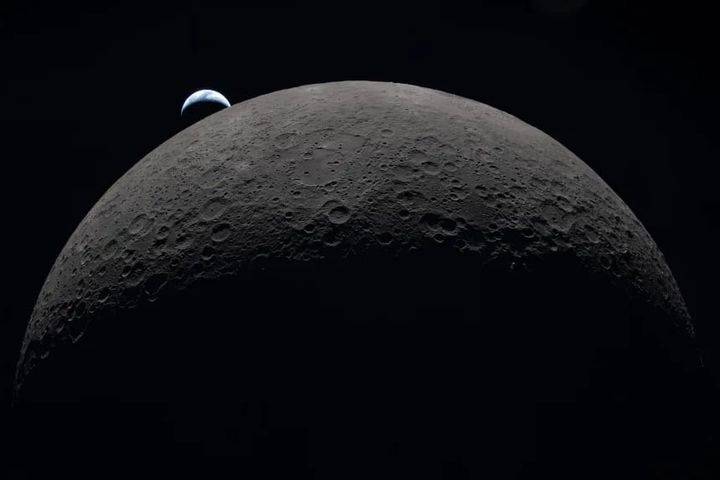
A photo of the Earth rising from behind the Moon, taken by astronauts the Artemis II mission
New 'Earthrise' photo just dropped. 📷: NASA

This issue of Posit is a little shorter, and takes a slightly different in approach. The loose (as always) theme of this issue is escapism, inspired in part by the latest visit by humans to the moon, and of course by all the news that is surely inspiring a longing for escape from this troubled planet. 

This one is a day late in going out. During that time, four astronauts ventured further from the Earth than any humans before. Also, the president of the United States promised the destruction of an entire civilization, in what amounts to a threat of nuclear war. It seems valid to say that a third world war is well underway, and in the hands of the current American administration, it is being given explicit religious connotations. From an editorial point of view, this is thematically consistent with a conversation about future thinking; the most obvious implication being that it calls into question the very idea of a future on Earth, at least for human beings.

Today, many of us envy the astronauts. 

Of course, escape is neither an option nor a solution to the problems we collectively face. “We’re all in the same boat”, and that includes the bastards trying their damndest to sink that boat just for the sake of claiming to have been the one to do it. Of course the Earth is neither a boat, nor a ship as Buckminster Fuller famously framed it. To think of it this way is useful to a point, except for the fact that we can understand, build, and repair a ship; we can confidently and reliably navigate a ship; and crucially, we can abandon a ship. None of those things are quite true of our relationship to the planet and its life webs which produce and reproduce us.

From Earth and the problems we face here, there is no escape. That might sound dire, but it should instead remind us that whatever needs doing to 'right the ship' can be done from exactly where we stand. We are the ship. Both times that Donald Trump was elected president, plenty of people thought about and in some cases acted upon the idea of escaping to another land—if he follows through with the threats made this morning, I suspect the hope of escape will be proven quite illusory. What can be done instead? All that I can think to do is to strive to enact the alternatives in my own limited sphere of influence—to foster stronger bonds with my neighbors, to make myself a resource to my community, to deepen my relationship to the landscape I occupy and the forms of life I share it with. In short, to deepen my roots where I find myself today, in order to better weather whatever storms will come; and they are certainly coming.

The boon of seeing the Earth from above—the famous ‘overview effect’, or in Carl Sagan’s famous reflections on the ‘Pale Blue Dot’—is supposed to be a recognition of the unity of all life on Earth, the illusion of separation by borders or class, race or creed. It is also known to be a humbling experience for all humanity, a recognition of the finitude and fragility of the ecologies that sustains us. 

We are being supplied with compelling new imagery of the Earth from beyond its atmosphere, while the most powerful and deranged people in the world threaten its destruction. Among other feelings, this is a reminder that the current, wicked world order cannot last; that it will and must end. This has always been true of unjust and unsustainable systems, or any attitude that fails to respect mother Earth (for more on this, see the Hannah Arendt excerpt at the bottom of this newsletter). One can only hope that the inevitable, welcomed end of this order leaves room for a better order to follow.


Furthermore

This is an interview with Austin Wade Smith, founder of the Regen Network (with whom I also spoke for an article in Noēma Magazine last year). They describe the concept of ‘ecological institutions’, a compelling concept that speaks at both granular and grandiose scales to the question of how we can organize society in a way that accords with the living planet from which we and all our systems and concepts emerge:

Friend and landscape designer Danielle VonLehe penned this beautiful reflection on the consequences of the 2025 Eaton fire in Altadena, and how solutions tied to commercial priorities that tend to abstract us from place may end up simply deepening the problems we seek to address: 

An Offering for the Commemoration | Los Angeles Review of Books
An Altadena landscape designer prepares to reseed her devastated town in the aftermath of the 2025 wildfires.

Related, an article from last year, by Rebecca Plevin at the LA Times, documents how the Eaton fire in Altadena was reduced around an acre plot returned in 2022 to Tongva stewardship—a small example of Landback success. (It is also hard to accept that the eucalyptus trees I loved so much as a kid growing up in Southern California were never meant to be there, and dramatically increased the risk of conflagration):

The Tongva’s land burned in Eaton fire. But leaders say traditional practices mitigated damage
Tongva community leaders credit traditional stewardship practices, including the removal of fire-prone eucalyptus, with reducing the wildfire’s impact.

Written in 2021 by professors Sarah T. Roberts and Mél Hogan, this article offers a clarifying exploration of the link between eschatology and escapism; the correlation between the search for a future of life beyond Earth with the acceptance that a future on Earth is neither viable nor desirable in the long term. It seemed relevant to this moment of globalized religious war and space exploration in preparation for bases on the moon and Mars:

Sarah T. Roberts and Mél Hogan — Left Behind: Futurist Fetishists, Prepping and the Abandonment of Earth
Sarah T. Roberts and Mél Hogan This essay has been peer-reviewed by “The New Extremism” special issue editors (Adrienne Massanari and David Golumbia), and the b2o: An Online Journal editorial board. “You know, I hear all these rich guys, for some reason they love space. So they’re rich. I said, ’let them send the rockets…

Another older article, this one from WIRED, is a long read from Laura Hudson, profiling philosopher Timothy Morton and the concept of the ‘hyperobject’, a vast, globalized process such as climate change or plastics or the solar system, within which we all live yet cannot truly comprehend. (Not for nothing, World War III surely counts as a hyperobject):

At the End of the World, It’s Hyperobjects All the Way Down
Do you feel lost? Alone? Powerless in the face of forces beyond your control? Timothy Morton can help—if you’re ready to have your reality blown apart.

Parting Thought

Under non-apocalyptic circumstances, the return of humans to lunar orbit would have been a dominant headline. Sadly, the news is full of far more pressing concerns, and for all the scientific promise and stunning images of our planet it produces, the mission rings as “whitey on the moon”. At a time when guided rockets and artificial intelligence and all manner of other advanced technologies are being leveraged to the worst imaginable ends, I was reminded of the prologue of Hannah Arendt’s 1958 book, The Human Condition. Prescient as always, she saw early on how the technological imagination gets ahead of humanity’s ability to understand their impacts, let alone to guide them—indeed, troublingly, the technologies we dream up end up guiding us, and rarely to a better world. 

“In 1957, an earth-born object made by man was launched into the universe, where for some weeks it circled the earth according to the same laws of gravitation that swing and keep in motion the celestial bodies—the sun, the moon, and the stars. To be sure, the man-made satellite was no moon or star, no heavenly body which could follow its circling path for a time span that to us mortals, bound by earthly time, lasts from eternity to eternity. Yet, for a time it managed to stay in the skies; it dwelt and moved in the proximity of the heavenly bodies as though it had been admitted tentatively to their sublime company.
This event, second in importance to no other, not even to the splitting of the atom, would have been greeted with unmitigated joy if it had not been for the uncomfortable military and political circumstances attending it. But, curiously enough, this joy was not triumphal; it was not pride or awe at the tremendousness of human power and mastery which filled the hearts of men, who now, when they looked up from the earth toward the skies, could behold there a thing of their own making. The immediate reaction, expressed on the spur of the moment, was relief about the first "step toward escape from men's imprisonment to the earth." And this strange statement, far from being the accidental slip of some American reporter, unwittingly echoed the extraordinary line which, more than twenty years ago, had been carved on the funeral obelisk for one of Russia's great scientists: "Mankind will not remain bound to the earth forever."

Such feelings have been commonplace for some time. They show that men everywhere are by no means slow to catch up and adjust to scientific discoveries and technical developments, but that, on the contrary, they have outsped them by decades. Here, as in other respects, science has realized and affirmed what men anticipated in dreams that were neither wild nor idle. What is new is only that one of this country's most respectable newspapers finally brought to its front page what up to then had been buried in the highly non-respectable literature of science fiction (to which, unfortunately, nobody yet has paid the attention it deserves as a vehicle of mass sentiments and mass desires). The banality of the statement should not make us overlook how extraordinary in fact it was; for although Christians have spoken of the earth as a vale of tears and philosophers have looked upon their body as a prison of mind or soul, nobody in the history of mankind has ever conceived of the earth as a prison for men's bodies or shown such eagerness to go literally from here to the moon. Should the emancipation and secularization of the modern age, which began with a turning-away, not necessarily from God, but from a god who was the Father of men in heaven, end with an even more fateful repudiation of an Earth who was the Mother of all living creatures under the sky?

The earth is the very quintessence of the human condition, and earthly nature, for all we know, may be unique in the universe in providing human beings with a habitat in which they can move and breathe without effort and without artifice. The human artifice of the world separates human existence from all mere animal environment, but life itself is outside this artificial world, and through life man remains related to all other living organisms. For some time now, a great many scientific endeavors have been directed toward making life also "artificial," toward cutting the last tie through which even man belongs among the children of nature. It is the same desire to escape from imprisonment to the earth that is manifest in the attempt to create life in the test tube, in the desire to mix "frozen germ plasm from people of demonstrated ability under the microscope to produce superior human beings" and "to alter [their] size, shape and function"; and the wish to escape the human condition, I suspect, also underlies the hope to extend man's life-span far beyond the hundred-year limit.

This future man, whom the scientists tell us they will produce in no more than a hundred years, seems to be possessed by a rebellion against human existence as it has been given, a free gift from nowhere (secularly speaking), which he wishes to exchange, as it were, for something he has made himself. There is no reason to doubt our abilities to accomplish such an exchange, just as there is no reason to doubt our present ability to destroy all organic life on earth. The question is only whether we wish to use our new scientific and technical knowledge in this direction, and this question cannot be decided by scientific means; it is a political question of the first order and therefore can hardly be left to the decision of professional scientists or professional politicians.

While such possibilities still may lie in a distant future, the first boomerang effects of science's great triumphs have made themselves felt in a crisis within the natural sciences themselves. The trouble concerns the fact that the "truths" of the modern scientific world view, though they can be demonstrated in mathematical formulas and proved technologically, will no longer lend themselves to normal expression in speech and thought. The moment these "truths" are spoken of conceptually and coherently, the resulting statements will be "not perhaps as meaningless as a 'triangular circle,' but much more so than a 'winged lion'" (Erwin Schrödinger). We do not yet know whether this situation is final. But it could be that we, who are earth-bound creatures and have begun to act as though we were dwellers of the universe, will forever be unable to understand, that is, to think and speak about the things which nevertheless we are able to do. In this case, it would be as though our brain, which constitutes the physical, material condition of our thoughts, were unable to follow what we do, so that from now on we would indeed need artificial machines to do our thinking and speaking. If it should turn out to be true that knowledge (in the modern sense of know-how) and thought have parted company for good, then we would indeed become the helpless slaves, not so much of our machines as of our know-how, thoughtless creatures at the mercy of every gadget which is technically possible, no matter how murderous it is.”

Subscribe to Posit

Sign up now to get access to the library of members-only issues.
Jamie Larson
Subscribe