A Basic Call to Consciousness
In 1977, the Haudenosaunee submitted a series of papers to the UN titled A Basic Call to Consciousness, presenting a still-resonant critique of western civilization from the perspective of a civilization that has existed for millennia.
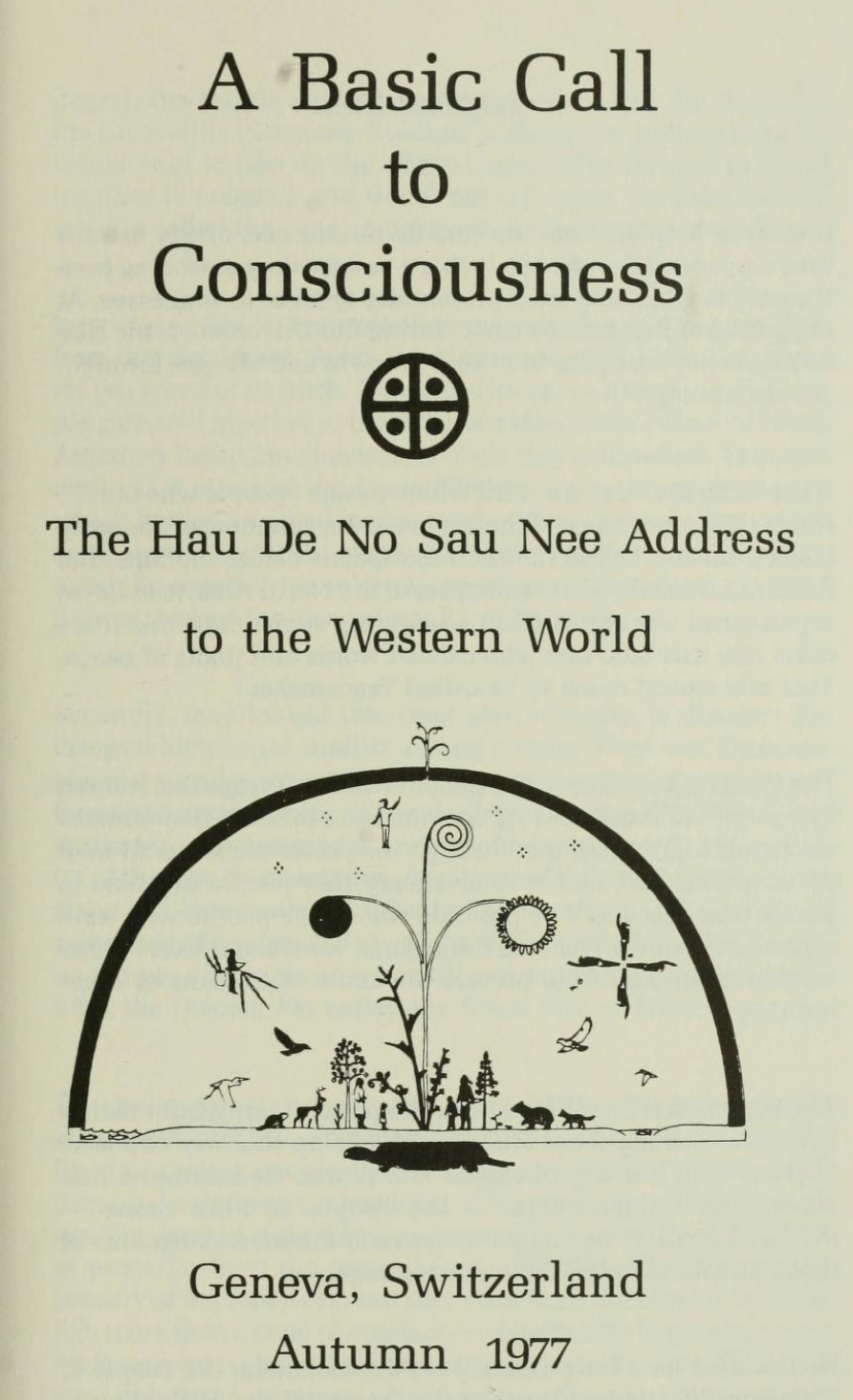
In September of 1977, representatives of the Haudenosaunee traveled to Geneva, Switzerland to deliver a statement to the United Nations, for the first International Non-Governmental Organization Conference on Discrimination Against Indigenous Populations. Their statement took the form of a set of position papers, gathered under the title A Basic Call to Consciousness.
Haudenosaunee means "people who build" though they are also commonly (and problematically) referred to as the Six Nations, or Iroquois Confederacy: the Mohawks, Oneidas, Onondagas, Cayugas, Senecas, and Tuscaroras. In Geneva, the Haudenosaunee led a delegation of around 145 representatives from throughout the Americas. Their purpose was to describe the oppression of their people since colonization—essentially, to bring the story of Europe's expansionist history, and its consequences, back to Europe. It represented a rare discussion of Indigenous human rights in the international arena. Perhaps the only precedent occurred in 1923, when Haudenosaunee Chief Deskaheh also traveled to Geneva to speak to the League of Nations.
The Basic Call to Consciousness is a compelling articulation of history as well as a truly ancient worldview and cosmology that read as more urgent and relevant than ever. They describe the point of view of a 'Natural People', as the papers put it, whose ongoing existence serves as a living reminder not just of a way of life that was decimated—though crucially, not destroyed—but also of ways of thinking, being, and relating that are drastically different from what most of us now take for granted as 'modern life'. The papers are presented as—and in fact one chapter is titled—an address to the western world. It names western civilization as a runaway process of alienation from and destruction of the natural world, as well as humanity's relationship to it, as well as to one another. As the book describes the statement, "It is, in a way, the modern world seen through Pleistocene eyes."