A Basic Call to Consciousness
In 1977, the Haudenosaunee submitted a series of papers to the UN titled A Basic Call to Consciousness, presenting a still-resonant critique of western civilization from the perspective of a civilization that has existed for millennia.
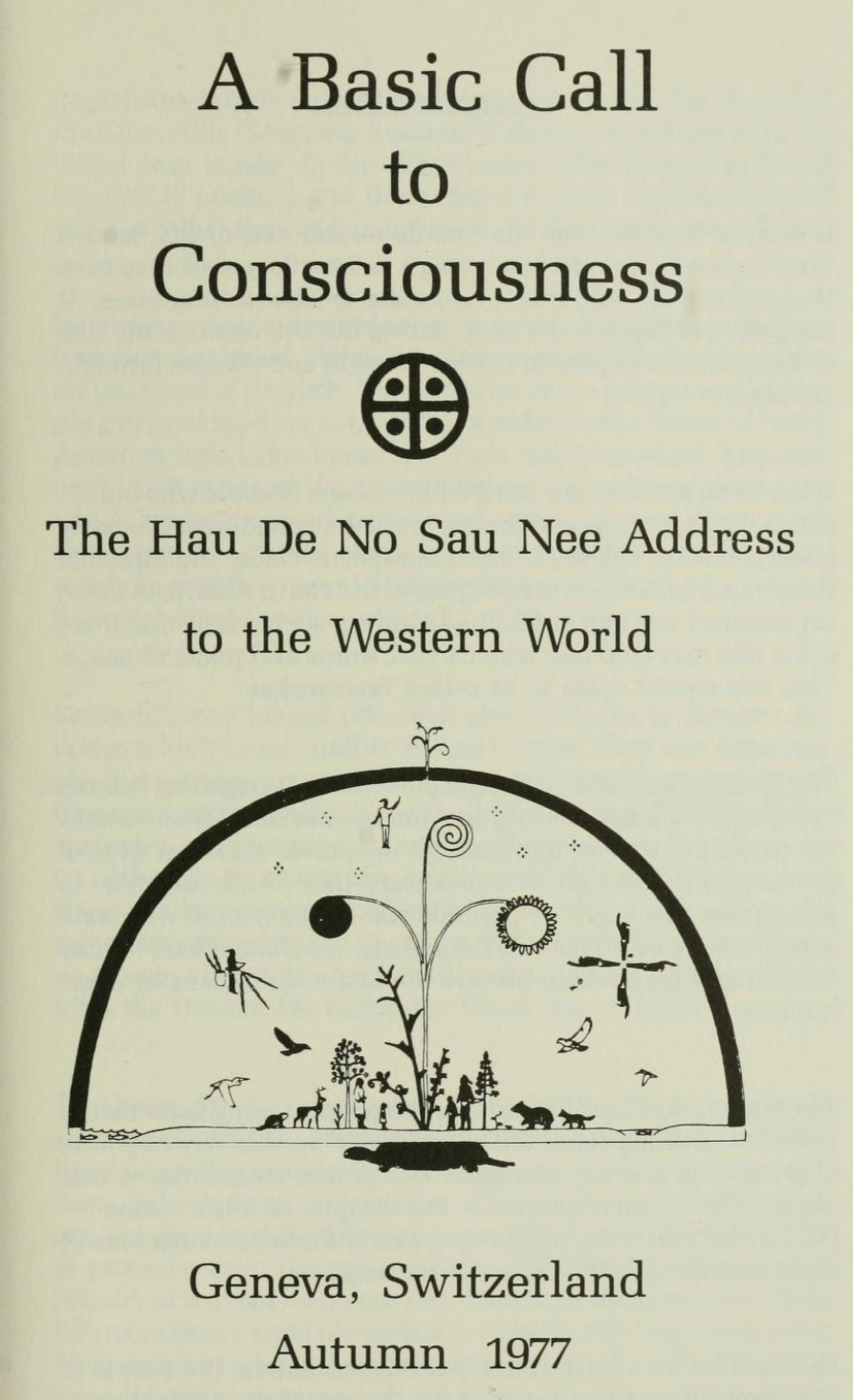
In September of 1977, representatives of the Haudenosaunee traveled to Geneva, Switzerland to deliver a statement to the United Nations, for the first International Non-Governmental Organization Conference on Discrimination Against Indigenous Populations. Their statement took the form of a set of position papers, gathered under the title A Basic Call to Consciousness.
Haudenosaunee means “people who build” though they are also commonly referred to as the Iroquois Confederacy: comprised of the Mohawk, Oneida, Onondaga, Cayuga, Seneca, and Tuscarora nations. In Geneva, the Haudenosaunee led a delegation of around 145 representatives from throughout the Americas. Their purpose was to describe the oppression of their people since colonization—essentially, to bring the story of Europe's expansionist history, and its consequences, back to Europe. It represented a rare discussion of Indigenous human rights in the international arena. Perhaps the only precedent occurred in 1923, when Haudenosaunee Chief Deskaheh also traveled to Geneva to speak to the League of Nations.
The Basic Call to Consciousness is a compelling articulation of history as well as a truly ancient worldview and cosmology that read as more urgent and relevant than ever. They describe the point of view of a 'Natural People', as the papers put it, whose ongoing existence serves as a living reminder not just of a way of life that was decimated—though crucially, not destroyed—but also of ways of thinking, being, and relating that are drastically different from what most of us now take for granted as 'modern life'. The papers are presented as—and in fact one chapter is titled—an address to the western world. It names western civilization as a runaway process of alienation from and destruction of the natural world, as well as humanity's relationship to it, as well as to one another. As the book describes the statement, "It is, in a way, the modern world seen through Pleistocene eyes."
It is a geological kind of perspective, which sees modern man as an infant, occupying a very short space of time in an incredibly long spectrum. It is the perspective of the oldest elder looking into the affairs of a young child and seeing that he is committing incredibly destructive folly. It is, in short, the statement of a people who are ageless but who trace their history as a people to the very beginning of time. And they are speaking, in this instance, to a world which dates back its existence from a little over 500 years ago, and per-haps, in many cases, much more recently than that. —A Basic Call to Consciousness
With this short post, I don't intend to give an exhaustive review of the papers, but to share a few sections that I find especially compelling, and to encourage you to read the whole thing for yourself. The papers were collated into a book that is available in full on the Internet Archive, if you sign up. Here's a link:
 Notes, Akwesasne
Though representing what amounts an ancient perspective, the analysis presented in these papers is unsurprisingly, highly sophisticated. It has been especially interesting to me in my pursuit of a perspective on the future that is rooted in the past.
It is important that we who are seeking ways of survival in the 20th Century begin by establishing new definitions and new fields of vision as we try to better understand the past. We need to look to history primarily because the past offers us a laboratory in which we can search to find that inherent process of Western Civilization that paralyzes whole societies and makes them unable to resist the process of colonization. We need to identify that process which so often leads people who are honestly seeking to resist and destroy colonization to unconsciously recreate the elements of their own oppression. And, lastly, we need to understand that within colonization are the exact elements of social organization which are leading the world today to a crisis which promises a foreseeable future of mass starvation, deprivation, and untold hopelessness.
The text often reads as a harrowing account of dispossession and displacement, but also of resilience and defiance of "victims of progress"— The book details the events leading up to, during, and following the 1977 Geneva meeting; it offers a detailed history of the legal oppression and erasure to the time of feudalism, as well as their economic history.
One thing that struck me while reading this book was how unfamiliar I am with the sheer cliff in my knowledge of pre-Revolutionary history of the continent on which I live. This landed especially while reading about the Peacemaker, a figure of titanic cultural importance, believed to have lived in the 12th century. The Peacemaker is regarded as the person responsible for bringing peace throughout the nations and vast territories of the Haudenosaunee, creating the foundations for a government that lasted centuries and inspired parts of the United States Constitution (and, evidently, also Marx).
The notion of a figure of such importance, now unknown to so many who live on the lands they influence, struck me as profound and poignant. I was also struck by the foundational difference between the logics of modern capitalism and liberalism, and the Earth rooted ways of thinking and being laid out in the book.
We feel that many people will be confused when we say that ours is a Way of Life, and that our economy cannot be separated from the many aspects of our culture. Our economy is unlike that of Western peoples. We believe that all things in the world were created by what the English language forces us to call "Spiritual Beings," including one that we call the Great Creator. All things in this world belong to the Creator and the spirits of the world. We also believe that we are required to honor these beings, in respect of the gift of Life.
The Haudenosaunee have no concept of private property. This concept would be a contradiction to a people who believe that the Earth belongs to the Creator. Property is an idea by which people can be excluded from having access to lands, or other means of producing a livelihood. That idea would destroy our culture, which requires that every individual live in service to the Spiritual Ways and the People. That idea (property) would produce slavery. The acceptance of the idea of property would produce leaders whose functions would favor excluding people from access to property, and they would cease to perform their functions as leaders of our societies and distributors of goods.
One subject in which I've been particularly interested lately is 'appropriate technology'. That is, a technology whose value is judged not by how fast or efficiently it is able to accomplish a task or generate a product, but by how many people it can help in doing the most socially meaningful or personally gratifying work.
Throughout the Basic Call to Consciousness, and particularly in the closing sections, a very similar concept is explored through the notion of 'liberaton technologies'; connected to the concept of liberation theologies, the concept is of practices—both the means and the meaning—that connect human activity to the cycles of nature, which of course are not separate from us, though our ways of being and thinking have underscored the sense that they are. Though written in 1977, the critique still reads as very apt today.
For the moment, there is more wealth, more goods and services, more automation than has ever existed in the history of mankind. The world is living in an age of manufactured affluence. But the people of the world have rarely been told the costs in terms of peoples lives and suffering that this affluence has extracted from each of us. Even the people in North America, who seemingly benefit from all these "advances" seem to be unaware of the destruction they are experiencing. The "Modern Age," and its consumer values, has altered, in very basic ways, the very structure of human society, and the basic conditions of the Natural World.
...
Our strategy for survival is to create and implement liberation technologies which are consistent with and complementary to a liberation theology which arises out of our culture and is the product of the Natural World. It happens that we, the Haudenosaunee, have fallen heir to a liberation political structure which may be the oldest continuously operating governmental system in the world. We know that our traditional worldview, and that our political structure was largely a product of the technological and worldview elements of our society.
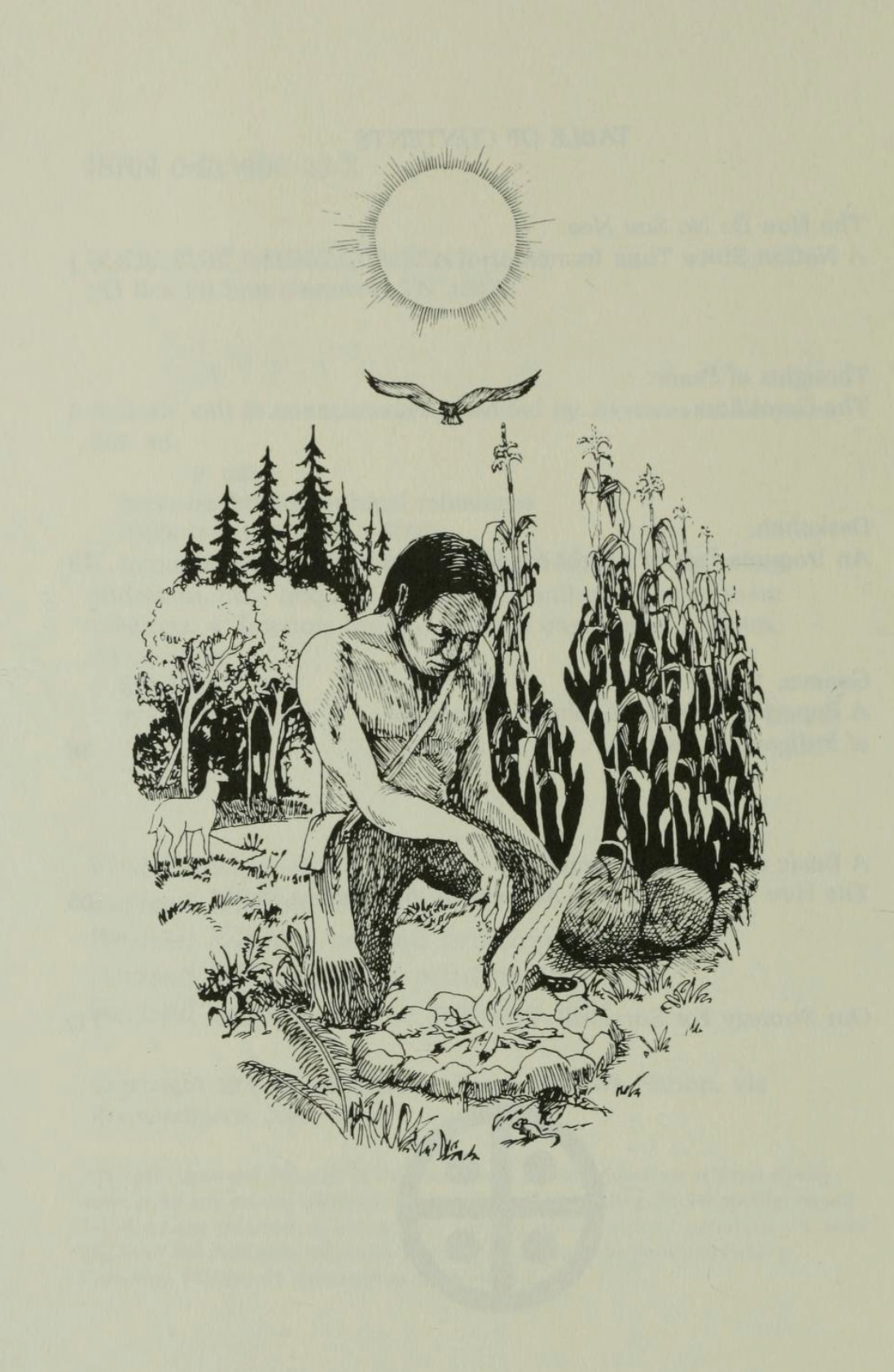
The final excerpt I'll share here is a lengthy one, from the section titled "The Haudenosaunee Address to the Western World". It's worth reading in its entirety. The core argument—that the ways of life being disrupted and destroyed by industrial 'civilization' are in face uprooting the means of humanity's ongoing survival—is more relevant than ever. To me, it reads as a searing indictment of the present status quo, but also a hopeful vision of what the future could be, one informed by ways of life that have lasted for millennia.
Today the species of Man is facing a question of the very survival of the species. The way of life known as Western Civilization is on a death path on which their own culture has no viable answers. When faced with the reality of their own destructive-ness, they can only go forward into areas of more efficient destruction. The appearance of Plutonium on this planet is the clearest of signals that our species is in trouble. It is a signal which most Westerners have chosen to ignore.
The air is foul, the waters poisoned, the trees dying, the animals are disappearing. We think even the systems of weather are chang-ing. Our ancient teaching warned us that if Man interfered with the Natural laws, these things would come to be. When the last of the Natural Way of Life is gone, all hope for human survival will be gone with it. And our Way of Life is fast disappearing, a victim of the destructive processes.
The other position papers of the Haudenosaunee have outlined our analysis of economic and legal oppression. But our essential message to the world is a basic call to consciousness.
The destruction of the Native cultures and people is the same process which has destroyed and is destroying life on this planet.
The technologies and social systems which have destroyed the animal and the plant life are also destroying the Native people.
And that process is Western Civilization.
We know that there are many people in the world who can quickly grasp the intent of our message. But experience has taught us that there are few who are willing to seek out a method for moving toward any real change. But if there is to be a future for all beings on this planet, we must begin to seek the avenues of change.
The process of colonialism and imperialism which have affected the Haudenosaunee are but a microcosm of the processes affecting the world. The system of reservations employed against our people is a microcosm of the system of exploitation used against the whole world. Since the time of Marco Polo, the West has been refining a process that mystified the peoples of the Earth.
The majority of the world does not find its roots in Western culture or traditions. The majority of the world finds its roots in the Natural World, and it is the Natural World, and the traditions of the Natural World, which must prevail if we are to develop truly free and egalitarian societies.
It is necessary, at this time, that we begin a process of critical analysis of the West's historical processes, to seek out the actual nature of the roots of the exploitative and oppressive conditions which are forced upon humanity. At the same time, as we gain understanding of those processes, we must reinterpret that history to the people of the world. It is the people of the West, ulti-mately, who are most oppressed and exploited. They are burdened by the weight of centuries of racism, sexism, and ignorance which has rendered their people insensitive to the true nature of their lives.
We must all consciously and continuously challenge every model, every program, and every process that the West tries to force upon us. Paulo Friere wrote, in his book, the PEDAGOGY OF THE OPPRESSED, that it is the nature of the oppressed to imitate the oppressor, and by such actions try to gain relief from the oppressive condition. We must learn to resist that response to oppression.
The people who are living on this planet need to break with the narrow concept of human liberation, and begin to see liberation as something which needs to be extended to the whole of the Natural World. What is needed is the liberation of all the things that support Life - the air, the waters, the trees - all the things which support the sacred web of Life.
We feel that the Native peoples of the Western Hemisphere can continue to contribute to the survival potential of the human species. The majority of our peoples still live in accordance with the traditions which find their roots in the Mother Earth. But the Native peoples have need of a forum in which our voice can be heard. And we need alliances with other peoples of the world to assist in our struggle to regain and maintain our ancestral lands and to protect the Way of Life we follow.
We know that this is a very difficult task. Many nation states may feel threatened by the position that the protection and liberation of Natural World peoples and cultures represents, a progressive direction which must be integrated into the political strategies of people who seek to uphold the dignity of Man. But that position is growing in strength, and it represents a necessary strategy in the evolution of progressive thought.
The traditional Native peoples hold the key to the reversal of the processes in Western Civilization which hold the promise of unimaginable future suffering and destruction. Spiritualism is the highest form of political consciousness. And we, the Native peoples of the Western Hemisphere, are among the world's surviving proprietors of that kind of consciousness. We are here to impart that message.



Comments ()