A Better Tomorrow Means Forgetting the Futuristic
The common sense of the future is leading to disaster. Instead, let’s imagine a tomorrow rooted in solidarity, maintenance, and Earthly reciprocity.
On a clear blue morning in the fall of 2021, Captain Kirk took his first trip to outer space. More precisely, it was William Shatner, the actor who portrayed that intrepid starship captain in the Star Trek films and TV series.
For decades, the adventures of the Starship Enterprise infused popular culture with an optimistic and progressive vision of humanity’s potential future. Influential people throughout science and industry openly claim Star Trek as inspiration for their work, and the motivation to make part of its vision for tomorrow a reality. One of them is Jeff Bezos, whose private rocket company was taking Shatner to the edge of Earth’s atmosphere. Shatner’s involvement lent cultural gravitas to the occasion, legitimizing the notion that it truly marked a bold step toward the best possible future. In that spirit, atop a comically phallic rocket, the cheery nonagenarian and his crewmates lifted off, and dared to knock at the door of the cosmos.
It was a devastating experience. As everyone else twirled rapturously in momentary microgravity, Shatner remained fixated on the view beyond the window, stunned by how suddenly the atmosphere gave way to the frigid void of space.
Just a few minutes later, the flight was over. The capsule parachuted down to thud on the scrubby Texas plain, where Bezos opened the hatch to greet its passengers. Celebrations ensued around the landing site, but Shatner withdrew to the sidelines. Fighting back tears, he tried to convey his feelings to Bezos, babbling incoherently about life, death, and Earth as mother. The billionaire listened in complete stillness, before interrupting Shatner’s reverie to vigorously uncork a bottle of champagne. As the crowd cheered, the actor demurred, gazing furtively down at his space sneakers.
“I had thought that going into space would be the ultimate catharsis of that connection I had been looking for between all living things—that being up there would be the next beautiful step to understanding the harmony of the universe,” Shatner wrote in a memoir published the following year. “It was among the strongest feelings of grief I have ever encountered. The contrast between the vicious coldness of space and the warm nurturing of Earth below filled me with overwhelming sadness.”
Shatner’s account is consistent with the so-called ‘overview effect’. The term describes the experience of astronauts who, upon seeing their home planet from beyond its atmosphere for the first time, report feeling a sudden, overwhelming recognition of its grandeur and beauty, as well as its finitude and fragility. The experience is said to be transformative, inspiring deep appreciation of the endless interconnectedness of all Earthly life, and our profound isolation amidst an endless universe.
Even the mere image of our Earth is enough to inspire an overview experience. Astronomer Carl Sagan evoked this in his famous ode to the ‘pale blue dot’, based on a photograph taken by the Voyager space probe. First published in 1990, the picture portrays the Earth from over three billion miles away. At such an absurd distance, our world registers as a faint pinpoint of azure light.
“There is perhaps no better demonstration of the folly of human conceits than this distant image of our tiny world,” Sagan wrote. “It underscores our responsibility to deal more kindly with one another, and to preserve and cherish the pale blue dot, the only home we’ve ever known.”

Such overview-inspired insights are hard to dispute. We truly are dependent upon the Earth and its entangled ecologies, and obligated to act as its responsible, humble stewards. So many of our concerns really do amount to trifles in the face of a vast, mysterious universe, and the inexplicable opportunity we have to exist at all. Yet despite the high technologies involved in conveying them, these perspectives are nothing new. Millennia of religious scripture, philosophy, Indigenous science and ways of knowing attest to humanity’s kinship with all life, the enigmatic nature of Nature, and humanity’s responsibilities as part of the inconceivably complex web of relations that includes all life and the Earth itself. Notably, in many cases, the societies that upheld these perspectives persisted for millennia.
There is no reason that a far-flung satellite can’t help us reconnect with our sense of the Earth and all upon it as sacred. Nor that our sense of humility and solidarity can’t be deepened by the new vistas and insights revealed by science, as Sagan's commentary suggests. Yet the technical and scientific progress that have made such things possible are often taken as cause for pride, even hubris, driving the perception of humanity as in some way separate from Earth, and superior to our nonhuman kin.
“We are as gods and might as well get good at it,” wrote Stewart Brand in the inaugural 1968 issue of his highly influential Whole Earth Catalog. On its cover, appropriately enough, was the first published image of the entire planet Earth taken from space, made public in large part due to Brand’s persistent pestering of NASA administrators.

At a press conference following his own first flight to the edge of space, Bezos also remarked on the impact of seeing the Earth from a great height. Clad in a tailored blue flight suit, eyes shadowed by the brim of a cattleman’s hat, he spoke with cultivated emphasis about having seen firsthand the planet's eggshell-thin atmosphere, and recognizing the profound unity of all that lives upon it.
Rather than inspiring an impulse to repair and reintegrate with that majestically interwoven and interdependent Earth, though, the billionaire leveraged his personal overview experience to further justify plans in which he had already been financially and ideologically invested for many years. “We’re going to build a road to space, so that our kids and their kids can build the future,” he asserted. “We need to do that, to solve the problems here on Earth.”
How, exactly, does building a road to space solve our problems back on Earth? The answer, if there is one, depends on who you ask. Bezos’s stated aim is to move heavy industry and resource extraction beyond Earth’s atmosphere. In essence, to provide the ‘picks and shovels’ for a new, potentially infinite cosmic gold rush. In his pitch for the future, this planet will be treated as a kind of nature preserve, our civilization’s metabolism freed to accelerate throughout the cosmos unfettered by pesky environmental or ecological considerations.
At the same time, Elon Musk, Bezos’s competitor for the title of richest person alive, and currently the world’s most influential nazi, is obsessed with establishing a permanent human presence on Mars. Though their projects differ in certain ways (Bezos is more focused on extracting quintillions of dollars worth of mineral resources from asteroids, whereas Musk seems bent on becoming the self-anointed godking of an extraterrestrial libertarian utopia), both are essentially betting that the ongoing advance of scientific, technological, and industrial development will doom humanity, unless we manage to escape the planet first.
As Mary Jane-Rubenstein writes, “These are the two utopias: ‘Fuck Earth and occupy Mars,’ versus ‘save Earth by drilling the universe.’”
It is possible that one— even both — of these future visions will come to pass in some form or another. If so, it will not necessarily represent an inevitable next step for mankind, but wish fulfillment for the world's richest individuals, and astronomical profits secured for their respective industries. There is nothing natural about these visions, beyond the fact that, as far as we can tell, nature also produced the men advancing them. These enterprises do not reflect deep wisdom or an enduring truth about the role and potential of humanity. Rather, they have been sold to a public already deeply indoctrinated by common mythologies about the future.
No one knows what the future holds, but that hasn’t stopped us from filling it with clichés. By the middle of the 19th century, driven by the incontestable momentum of the industrial revolution, a familiar vision of the future had begun coalescing in the public mind. It was defined by cheap energy, casual access to the far reaches of Earth and outer space, intelligent robots, gleaming megacities—you know the list, and that’s the point.
The most optimistic future visions portray humans living in comfort, peace, and abundance, dividends of constant and inevitable scientific, technological, and social progress. By the end of the second World War, especially in the culturally and economically ascendant United States, the shape of the future as we know it today was etched into the public imagination, shaping common expectations and aspirations. Sure enough, the early 21st century bears some superficial resemblance to these visions, seeming to validate them even as the future grows increasingly uncertain.
Today, sleek rockets regularly arc across the skies, machines are taking over not just manual but also cognitive and creative labor, while even flying cars—those familiar, fetishized harbingers of the future—are floating into view. Of course, the future is just as often portrayed in dark and cautionary terms. Distressingly, these darker visions also seem prescient, as extreme weather grows more calamitous every year, global biodiversity collapses, and conflicts around the globe slide deeper into forms of barbarity once thought relegated to the shameful past. All of this is driven by extractive industries and capital interests that, by their very nature—or rather, their abstraction from nature—are inherently set against a future reflective of our common condition as Earthlings; of our shared responsibility to one another, the planet, and all life.
What is unsustainable must inevitably come to an end. Accordingly, we are seeing and experiencing the collapse of an order built on untenable extraction, pollution, and profound inequity. One need only look at the mounting consequences of climate change to recognize that human civilization has innovated its way into existential uncertainty, and that we must fundamentally alter the ways we think and operate if we wish for humanity to survive, let alone to ‘make progress’ in any meaningful sense.
Star Trek pictures humanity after it has finally mastered the technologies that can permanently solve material scarcity, inequity, and others among “the problems here on Earth”. It is fairly obvious why Jeff Bezos would want to associate his works with that vision. Never mind that most of these problems share political and social roots, and are immediately solvable (if only in theory) without the need for advanced technology. Never mind that the course of 'progress' is demonstrably leading our species into catastrophe. The strident advancement of technology and industry over the last two centuries have been taken as model of the one and only proper course for humanity, indicative of the centuries and even millennia to come.
Given what it has revealed about the workings of the universe, and the material benefits it has brought, it is understandable why science is seen as the path to a greater Truth as to humanity's role and potential. However this is often taken to extremes, including by some of the world's most powerful and influential people. For instance, the breakneck pace of technological and scientific development over the last century has led many to expect what amounts to a secular rapture, referred to as ‘the singularity’, in which humans transcend our bodies to merge with the ultra-intelligent machines that we've devised. Either that, or some kind of man-made armageddon, the self-destruction of our species and perhaps the whole planet due to the unleashing of great powers beyond our control.
A future that eludes most forecasts is one of a slower civilizational metabolism; of reintegration with ecological cycles, and the return to stewardship rather than total domination of the planet. There have been efforts at advancing this less intuitive form of futurity, and potent social movements aimed at realizing a more frugal, ecologically convivial society. For instance, in discourses around degrowth and ecosocialism, or in marginal imaginaries such as solarpunk, Afrofuturism, and Indigenous futurism. In the 1960s and 1970s, the New Leftists, back-to-the-landers, bioregionalists, and other radicals also tried to reorient social priorities along these lines, largely in reaction to exorbitant postwar consumerism and militarism.
Though influential, none of these future visions ever gained broad purchase in the public mind quite the way popular science fiction managed to achieve. Every scientific or technological achievement, each new shiny electronic gizmo, is naturally perceived as another fragment of the future we’ve been conditioned to expect; a promise fulfilled. They seem to be coming to us not from the factories of wealthy industrialists, but from the future itself.
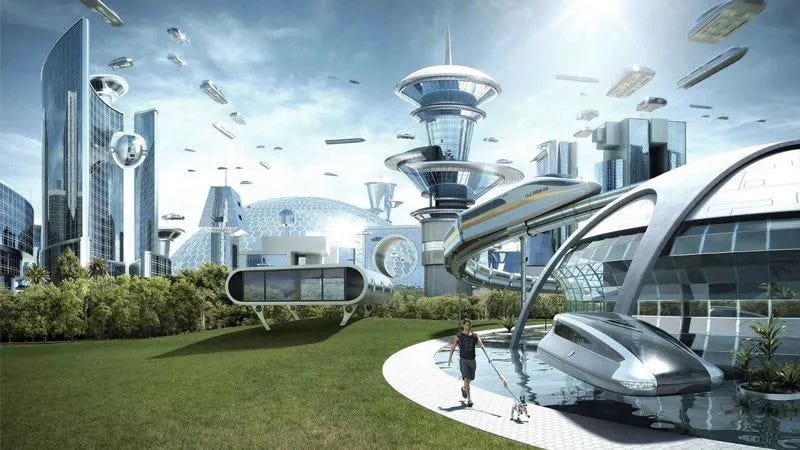
The signifiers of the futuristic are established enough to leave little room for any truly radical imagination of what a better future could entail. This reflects some small part of what the late cultural and media theorist Mark Fisher called the “slow cancellation of the future”, describing our collective inability to see beyond the world as envisioned by capitalism, therefore making it impossible to picture anything beyond what is already present and familiar. This helps to explain the increasing cultural force of nostalgia that began gaining currency around the turn of the millennium, reiterating and reinforcing rather than challenging or expanding the collective imagination.
The future as we often think of it today is a concept with a relatively short history, after all. People born in the last two centuries have seen more change in their lifetimes than was seen for millennia prior, lending to the common expectation of a future that will and must always be radically different from the present. The rate and intensity of change, it has been assumed, can only continue and accelerate ad infinitum.
Conversely, the future that preoccupies us also tends to be limited to a relatively short-term outlook. It’s difficult enough to picture what the world may look like a decade from now, let alone in a century, or two, or ten. The further into the future we project, the more our prognostication becomes an exercise in imagination, or pure physics. Science can tell us accurately when the sun will become a red giant and engulf the Earth. Beyond the question of a livable climate, though, it can say little about where—or even whether—humanity will be as a civilization in the coming decades. All of this is to say nothing of where humanity should be headed, which is a question perhaps best posed to societies that managed to live sustainably for millennia.
Nevertheless, influential people at the top of both the economy and politics embrace some version of what is known as a ‘longtermist’ view, justifying their social advantage today for the purported good they and their technologies may do for the untold trillions of people yet to be born. The interests of those as-yet hypothetical people do matter, of course—it behooves us to be ‘good future ancestors’. Yet we cannot speak to their needs and desires any more than they can currently speak for themselves. It is therefore incumbent on those now living, and those yet to live, to do the best we can with the world as we find it in our time. The alternative is to drastically reshape it on the basis of a future that we simply cannot predict, and which may never come to pass.
The stories we tell ourselves about the future matter, not necessarily because they are accurate—that is rarely the case. Rather, it is because of their power to reshape culture, our collective beliefs and priorities, in the here-and-now. Future thinking can inspire and justify efforts to realize a certain vision of the world, providing something to look forward to, to work for, or just as often, to avoid. Although the future never truly arrives, it is “Always also influential in the present,” writes social theorist Jeroen Oomen and colleagues. “Societies develop and adopt tools and social technologies to render the future actionable.”
In the early 21st century, questions as fundamental as whether democracy will survive the next election cycle, or if the Earth itself will remain habitable within the lifetimes of people already born, are open and opaque. Meanwhile, developments like 'artificial intelligence' are delivering yet another wave of social, economic, and environmental disruption, with dramatic and unpredictable consequences. In the midst of what has been dubbed a polycrisis—a tangled nexus of social and environmental challenges facing the human civilization at all scales—the models of the future which we have ready at hand grow increasingly unreliable for the task of building a better world.
A future worth pursuing will probably place the highest priority not on endless economic growth, nor the realization of some gleaming techno-utopian dream, but rather on respect and care for the planet and all life upon it, human and more-than-human alike. It will focus on repairing connections with lines of tradition based on reciprocity with our environment, of the sort that saw much of humanity through to the point of transition in which we now find ourselves. Any future worth looking forward to, in other words, will involve a rebuke of the familiarly ‘futuristic’, and focus instead on reviving and sustaining a relationship with the present as well as the past.
It is long past time to embrace a different picture of futurity than the one we’ve inherited from extractive industries and out-of-touch billionaires. That picture might not look as shiny as what we’ve come to expect, but then again, the gleaming techno-utopian dream of the billionaires has already proven that it will only lead to a less vibrant, less biodiverse, less convivial world. Instead, we should turn to communities working to reclaim, repair, and maintain vital connections to the living planet and among one another, carrying forward ways of knowing and being that we can’t afford to leave behind. Doing so does not require forsaking the many benefits of technological and scientific progress. It does require seeking guidance from beyond empty technosolutionism and the bankrupt visions of billionaires who promise to take humanity to the stars, at the expense of both the Earth and our fundamental nature as Earthlings.