An Ingenious, Indigenous Intervention at the Met
In December, I was witness to a break-in of sorts at the Metropolitan Museum of Art. Just a couple months prior, the Louvre had been ransacked in broad daylight heist fit for a popcorn movie, involving cranes, costumes, power tools, and escape scooters. This was very different. Works of art had in effect been quietly smuggled into the Met, the point not to plunder but to claim space and impart an important message.
ENCODED: Change the Story, Change the Future opened on Indigenous Peoples’ Day, placing 25 works by 17 Indigenous artists throughout the American Wing of the Met. It was essentially a guerrilla exhibition, one that existed in the realm of 'augmented reality', as a digital layer placed precisely upon works throughout the gallery. visible only through a phone or tablet.
The American Wing includes many images depicting the pastoral American landscape and the figures who 'conquered' it. It should be noted that the museum has made an efforts to center Native artists and the fact of its existence on stolen land—for instance, displaying Indigenous art in the American Wing, hiring a curator of Native American art, and commissioning a pair of paintings by Cree artist Kent Monkman. However these images and the history they portray—of the continent as a terra nullus or a 'land without a people', waiting to be claimed—still underpins the 'facts on the ground' of both the museum itself and the nation writ large.
According to the intervention's organizers, "ENCODED takes place on Lenapehoking, the homeland of the Lenape people. The Lenape were forcibly removed from this land. ... ENCODED is not a protest, or a demand for inclusion, it is a ceremonial act of remembering and reimagining; it is a portal inviting us to see what happens when new narratives enter old frames. ... This is more than an ephemeral exhibition. It is a movement of many movements: this exhibition extends beyond the museum as a reminder of what has always been here and is an offering of a collective imagination towards a shared future."
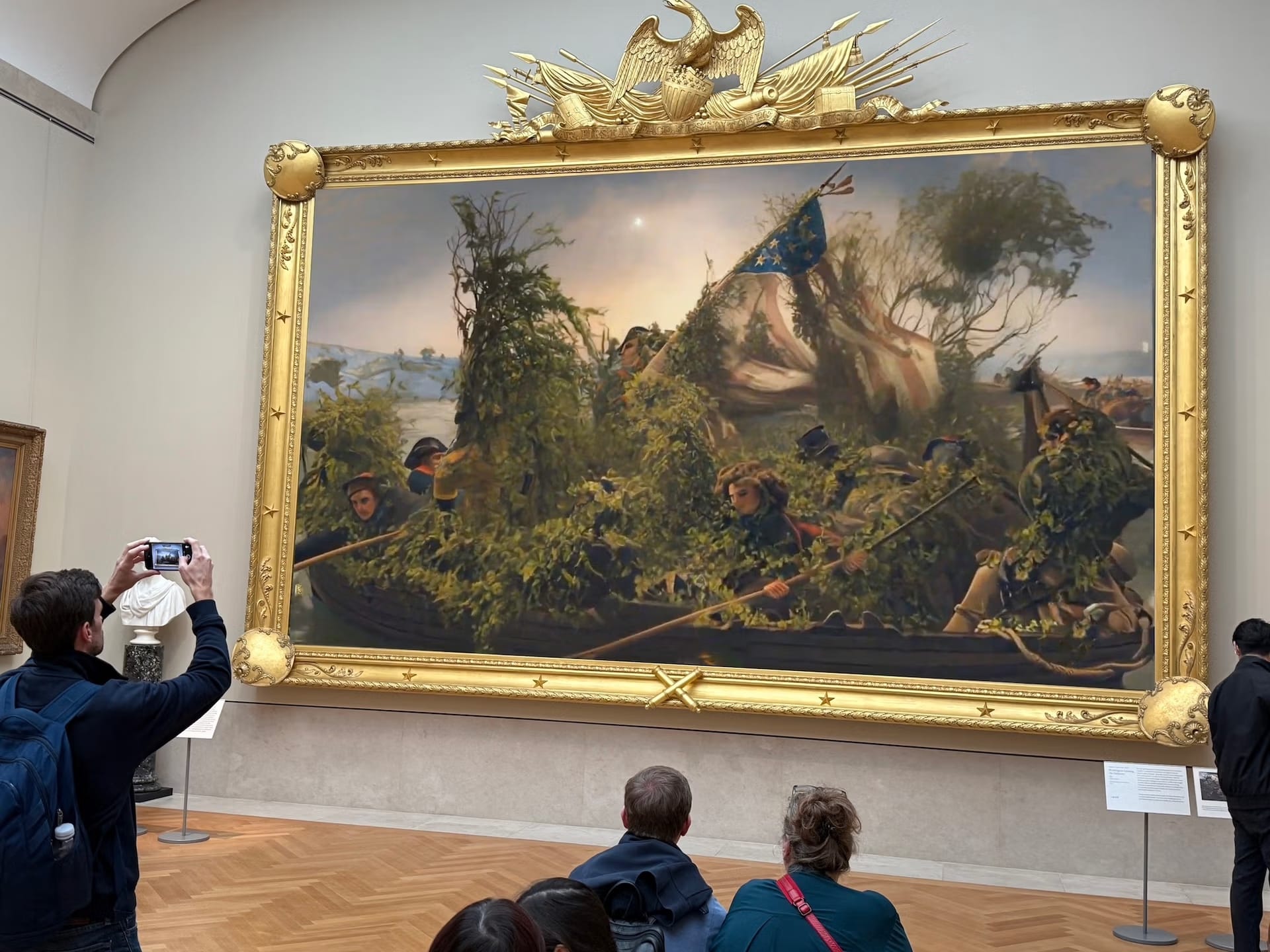
After a journey through the museum labyrinthine, my friend and I located the American Wing, and were confronted with the imposing visage of Washington Crossing the Delaware by Emanuel Leutze (1851), undeniably the centerpiece of the entire wing. Looking through our phones, it was disrupted in appropriately defiant manner with an animated piece by the enigmatic artist known as Flechas. Through our phones, the all-too-familiar image of Washington and his gang was quickly overtaken by unfurling front of vines and ferns and forest growth. The landscape underwent millennia's worth of transformation in a matter of seconds, as a child spoke:
This painting once spoke of conquest. Yet the River flowed before the oars, and the Land endured before the clash of battle. To step into the future, we must walk with balance, remembering that history is more than victories and losses. The river carried stories long before Washington raised a flag, and it will carry countless more when his name is but a whisper. The Earth holds truths deeper than conquest, and it is our choices that determine which stories will live on for generations to come.
At the end of the sequence, the view turned to the stars and settled on a single word that was also the title of the piece: Landback. Given its scope and the visceral familiarity of the material it disrupted, this intervention was particularly impressive, but each piece in ENCODED was compelling in its own right.
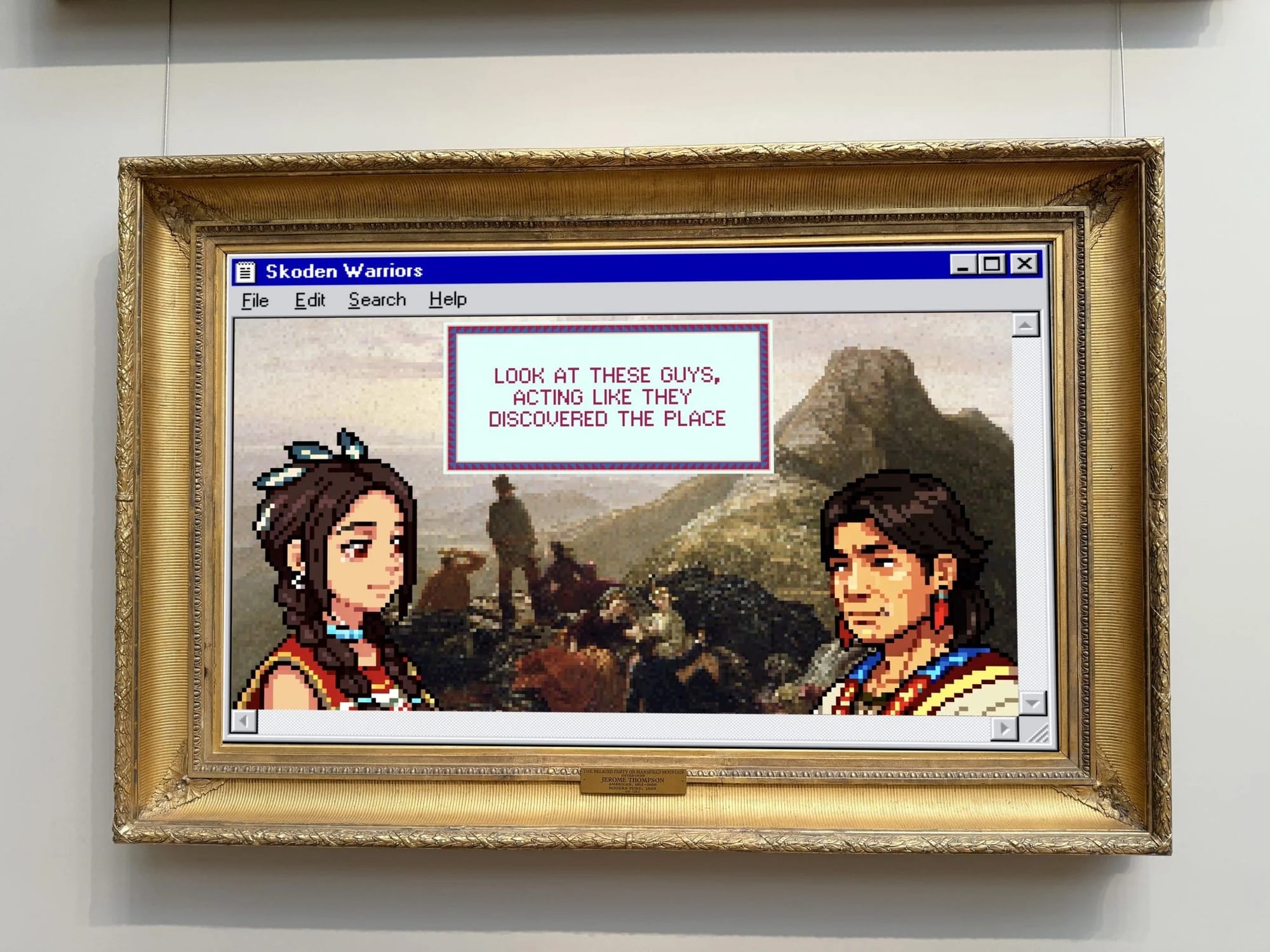
With Gifts from the Ancestors by Katsitsionni Fox, a large, weeping clay vessel that engulfed an 1876 piece called called Indian Vase by Ames Van Wart; Right next to it, The Skoden Warriors by Cass Gardiner, a pair of mocking 8-bit video game characters were overlayed upon The Belated Party on Mansfield Mountain by Jerome B. Thompson (1858), in a nod to The Oregon Trail video games.
Before a 1780 portrait of George Washington by John Trumbull, a three-dimensional grenade made of woven Brown Ash bark—produced by Lokotah Sanborn accompanied by music from Mali Obomsawin—paid homage to Penobscot and Passamaquoddy warriors joined the American Revolution under false promises of retaining their ancestral lands. Outside the museum, hovering over the museum's entryway steps, were a superhero-style representation of the Three Sisters.
Of particular interest to me—as a fan—was the work of Cannupa Hanska Luger, which also happened to pop up more than most others in this intervention upon the American Wing. I mean that somewhat literally, as his contributions took the form of dancing figures that would emerge from famous landscape paintings, gradually and defiantly making their way toward the viewer. These figures, or Midéegaadi, were from a series called Future Ancestral Technologies, representing elemental forces such as water and thunder. The Midéegaadi figures are, in Luger's telling, calling the bison back to the American landscape through dance.
According to Luger in a press release about the event:
“The works that I’m presenting are an intervention on a narrative that American art, and the American art canon, has maintained, which is that the landscape of North America was void of population. ... Their dancing is a symbolic representation of a culture that thrives and survives the static aspect of history. Having them move on these static paintings, I think, reinforces the idea of our survivants and our continued existence under the oppressive weight of being omitted from history.”
Let's be honest—augmented reality is generally pretty wonky and annoying. The use of a phone to interact with the environment is by its very nature severely limited and cumbersome; you certainly won't catch me wearing an AR-ready set of glasses to the museum or anywhere else. Yet the ENCODED experience—realized by the media and design nonprofit Amplifier—is probably the most compelling use of the technology I've encountered. This is largely because it was not trying to draw attention to the medium, even if in this case the medium was very much part of the message.
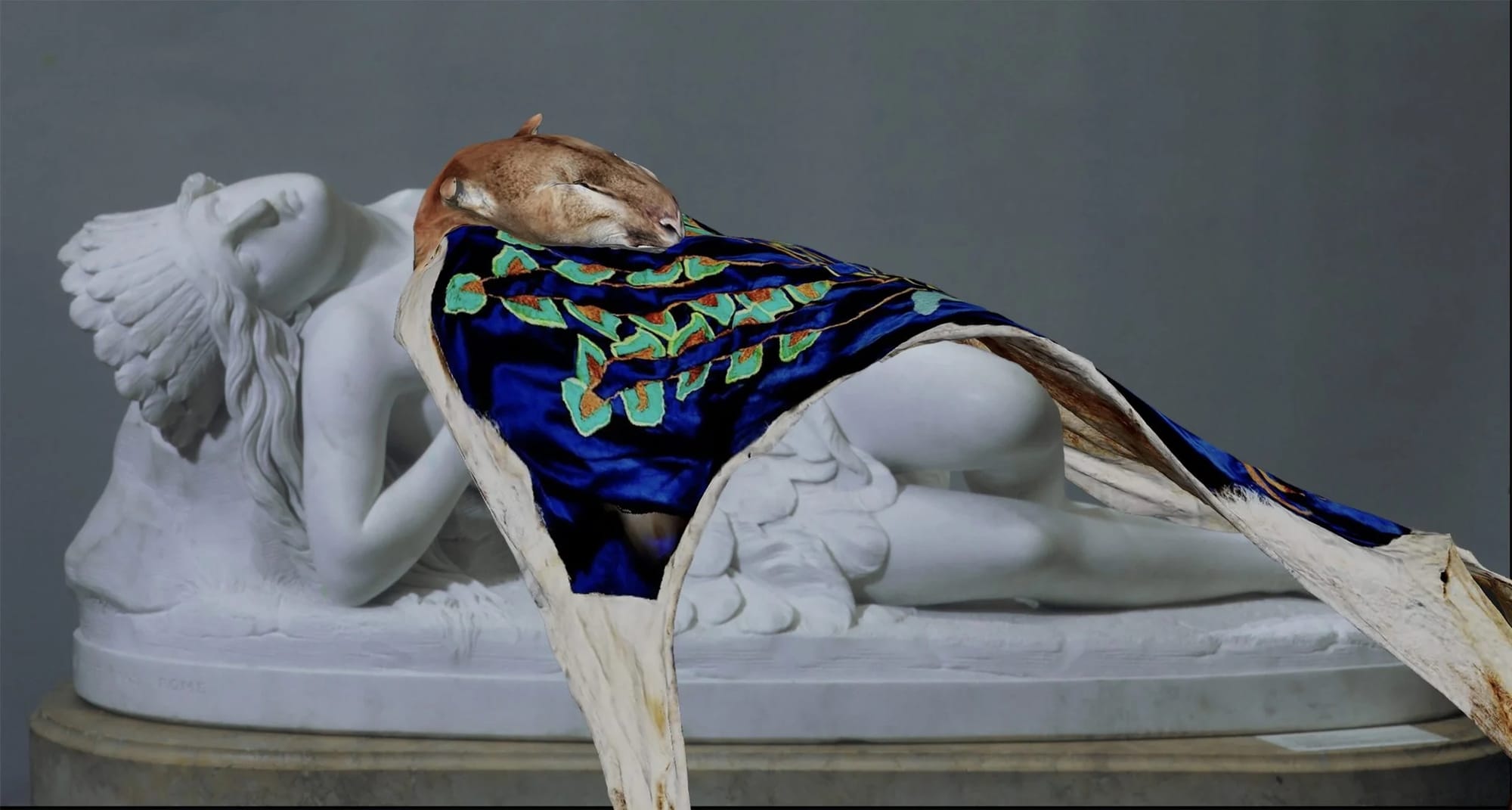
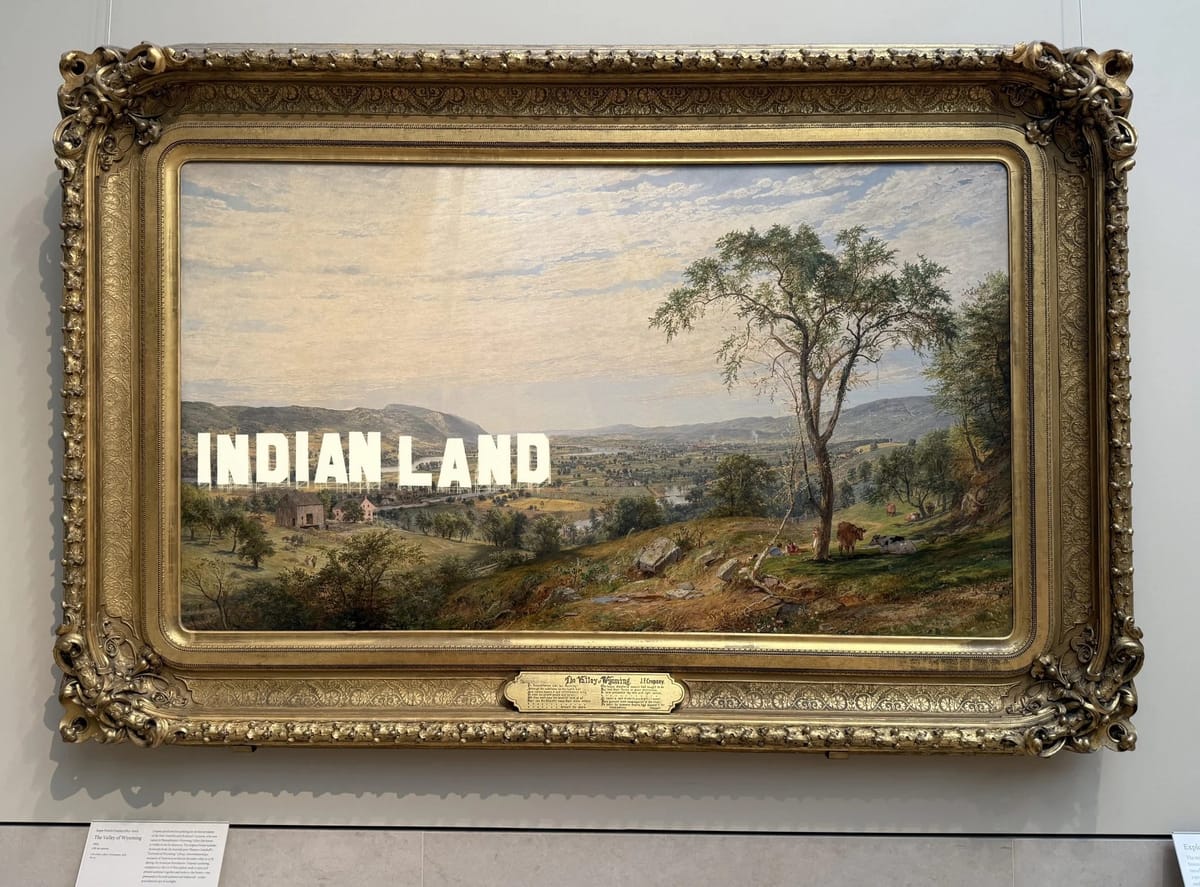
Moving through the gallery to find the insurgent artworks became something of a treasure hunt for my companion and I. Each became a moment of discovery, as we wondered what intervention the source material would inspire. Some were profound, others humorous and playful, such as a Monty Python-esque animation of a landscape filled with chintzy architecture, as a plane flies overhead trailing a banner reading "This is Indian land." Overall, though, the effect of searching for otherwise invisible signs of Indigenous presence itself became something of import. The work was clever, compelling, and resonated with a sense of righteous defiance, but you wouldn't know it was there if you weren't looking for it. That fact itself seemed to reflect something of the ongoing power dynamics against which first peoples have struggled since colonization began. For all the efforts at recognition on the part of the Met, other institutions, the nation itself, any truly subversive message must be smuggled in; the real estate is not likely to be handed back to its rightful stewards.
There is a phrase that shows up frequently in Luger's work: "We survive you." It serves in part as a reminder of the ongoing presence of first peoples, despite the immense, hyper violent efforts at complete erasure. It's a narrative common to colonial landscapes. The monumental structure of a building like the Met, embedded as it is in the heart of a vast, hardened metropolis, suggests the permanence of the powers that built it. To wander its halls while receiving defiant messages from Indigenous artists seeking to correct or complicate that narrative, the permanence of it all seemed a little less certain.